Lighting, Exterior (LE)
Overview
Lighting Exterior check group addresses exterior lighting and controls. Table 8 summarizes the checks included in this group.
Table 8: Lighting, Exterior Checks Overview
| Focus of the Check | Type of Check | Proposed Design | Baseline/Budget Design |
|---|---|---|---|
| Lighting Power | CF inputs reflect design documents | LE01-P | NA |
| CF inputs reflect requirements of ECB/PRM | NA | LE01-B | |
| Meet mandatory requirements | LE02-P | NA | |
| Simulation inputs consistent with CF | LE03-P | LE03-B | |
| Simulation outputs consistent with CF | NA | NA | |
| Lighting Controls | CF inputs reflect design documents | LE04-P | NA |
| CF inputs reflect requirements of ECB/PRM | NA | LE04-B | |
| Meet mandatory requirements | LE05-P | NA | |
| Simulation inputs consistent with CF | NA | NA | |
| Simulation outputs consistent with CF | LE06-PLE07 | LE06-BLE07 | |
| Legend: PASS/FAIL/NA outcome is determined automatically in the Quality Control Checks tab of the Compliance Form. | |||
The following strategies may be used to prioritize the review:
- For checks that verify the specified fixture wattages, focus on fixtures that account for the largest total exterior wattage on the project and spot-check the rest.
- For checks that verify the specified fixture counts, focus on exterior application types that account for the largest total wattage and spot-check the rest.
- Exterior lighting allowances and controls prescribed in 90.1 Section 9 are mandatory and must be met where applicable. Perform the checks to verify that mandatory requirements are met using the prioritization techniques described in #1 and 2 above.
- For ECB projects, exterior lighting trade-offs are not allowed (i.e., the exterior lighting is not an impactful end use), thus review is limited to verifying that the reported exterior lighting wattage and controls are as specified and meet the mandatory requirements.
For 90.1 2022 PRM alterations subject to G3.3 (i.e., Minor Alterations), the summary tables on the Quality Control Checks tab in the Compliance Form may not reflect correct values for the baseline since projects, for the most part, only enter proposed design information and provide notes as to what was modeled in the baseline in the notes fields associated with the proposed design related tables. Refer to the 90.1 2022 Section G3.3 Performance Calculations for Other Alterations section for more information regarding 90.1 2022 G3.3.
LE01-B Baseline/Budget exterior lighting Power is established correctly in the Compliance Form
90.1 2016 and 2019/2022 ECB
Table 11.5.1 No 1 Column B/ Table 12.5.1 No 1 Column BExcept as specifically instructed in this table, all building systems and equipment must be modeled identically in the budget building design and proposed design. Exterior lighting is not explicitly listed in Table 11.5.1/12.5.1, this is not a trade-off opportunity and must be modeled the same in the Budget building as specified in the proposed design.
90.1 2016 and 2019 PRM
Table G3.1 No 6, Baseline Building Performance columnExterior lighting in areas identified as “Tradable Surfaces” in Table G3.6 must be modeled with the baseline lighting power shown in Table G3.6. Other exterior lighting must be modeled the same in the baseline building design as in the proposed design.
90.1 2022 PRM
G3.2 New Construction/Major AlterationsSame as the Table G3.1 No 6, Baseline Building Performance column requirements described above for the 90.1 2016 and 2019 PRM.
G3.3 Minor Alterations
Alterations subject to Section G3.3.2.7 (i.e., Minor Alterations) are required to model tradable
exterior lighting as minimally compliant with 90.1 Section 9.1.1.3.2 in the baseline design
model.
Review Tips
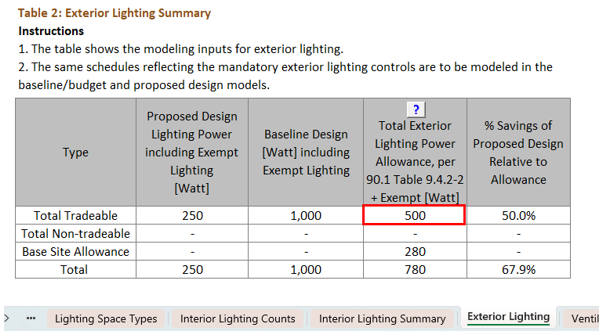
- Baseline/budget exterior lighting wattage is shown in Table 1 of the Exterior Lighting tab. It
is established automatically based on the following user inputs (refer to the
90.1 2022 Section G3.3 Performance Calculations for Other Alterations
section for the location of the baseline lighting wattage for alterations subject to 90.1 2022
Section G3.3):
- Project’s exterior lighting zone based on 90.1 Table 9.4.2-1
- Exterior lighting applications for which lighting is specified in the proposed design.
-
The surface area or length of the exterior lighting application (e.g., area of the
parking that or length of entrance door) that has exterior lighting specified in the
proposed design.
- Confirm that an appropriate exterior lighting zone is selected for the project based on the
definitions below from Table 9.4.3-1:
- Zone 0: Undeveloped areas within national parks, state parks, forest land, rural areas, and other undeveloped areas as defined by the authority having jurisdiction
- Zone 1: Developed areas of national parks, state parks, forest land, and rural areas
- Zone 2: Areas predominantly consisting of residential zoning, neighborhood business districts, light industrial with limited nighttime use and residential mixed use areas
- Zone 3: All other areas
- Zone 4: High-activity commercial districts in major metropolitan areas as designated by the local jurisdiction
Some AHJ and RAs may specify the exterior lighting zones that must be used based on the project address.
-
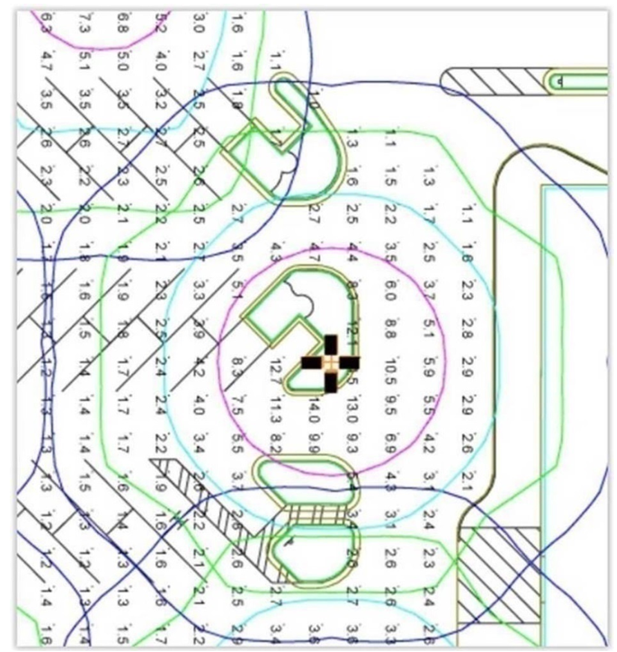
Use Table 1 of the Exterior Lighting tab to identify exterior lighting applications with the
greatest difference in wattage between the baseline and proposed design. Refer to the exterior
lighting plans drawings to confirm that entered surface area or length are not exaggerated. The
input must reflect the area or length of the surface in the proposed building that is
illuminated to some industry standard, such as the IESNA Handbook. It is the responsibility of
the design team to identify the illumination design standard and the area actually illuminated,
as illustrated in the following figure.
- Only the areas that are illuminated without obstruction may be included.
- Each portion of the illuminated area must only be assigned one lighting application consistent with the actual use of the area. Any overlapping area of another lighting application, such as a pathway crossing the parking lot, must be subtracted from the area of the other lighting application.
- The allowed area of a site roadway, driveway, sidewalk, walkway or bikeway should be determined as either the actual paved area plus 5 feet on either side of the centerline path of travel; or a 25-foot-wide area running along the axis of the path of travel and including as much of the paved area of the site roadway, driveway, sidewalk, walkway or bikeway as possible.
- Common Mistakes
- Modeling different exterior lighting between the budget and proposed design with the ECB path.
- Including areas of the proposed design that are not illuminated, or incorrectly accounting for partially illuminated areas, when calculating the baseline exterior lighting power. For example, if the proposed design has an uncovered parking lot that has no lighting specified, the exterior lighting allowance for the uncovered parking areas in 90.1 Table G3.6 cannot be included in the baseline.
- Double-counting areas when calculating the baseline exterior lighting power allowance. For example, the baseline lighting allowance for the walkway that crosses an illuminated parking lot can be determined based on the parking lot allowance, or walkway allowance in 90.1 Table G3.6, but not both. If walkway allowance is used, the walkway area calculated as described in #3 above must be subtracted from the parking lot area used to calculate the parking lot baseline lighting allowance.
- Modeling baseline lighting for non-tradeable surfaces based on the full allowance in 90.1 Table 3.6. The baseline non-tradeable lighting must be modeled as specified in 90.1 Table G3.6 or based on the proposed lighting for each non-tradeable application, whichever is lower.
LE01-P Proposed exterior lighting power reported in the Compliance Form reflects design documents.
90.1 2016 and 2019/2022 ECB
Table 11.5.1 #6 Column A (a) and (b)/Table 12.5.1 #6 Column A (a) and (b)Where a complete lighting system exists, the actual lighting power should be used in the model. Where a complete lighting system has been designed, lighting power must be determined in accordance with Sections 9.1.3 and 9.1.4.
90.1 2016, 2019 and 2022 PRM
Table G3.1 No.6 (a), (b), (d)- Where a complete lighting system exists, the actual lighting power should be used in the model. Where a complete lighting system has been designed, lighting power must be determined in accordance with Sections 9.1.3 and 9.1.4.
- Where a lighting system has been designed, lighting power must be determined in accordance with 90.1 Sections 9.1.3 and 9.1.4.
- The input wattage of specified fixtures must include all power used by the fixture including lamps, ballasts, transformers and control devices and be based on the manufacturers’ labeled maximum wattage of the luminaire. The lamp and ballast combination shown on drawings may result in lower input wattage that the maximum rated and thus cannot be used for compliance calculations.
Review Tips
- The exterior lighting wattage is reported in Table 1 of the Exterior Lighting tab and include
the following:
- Lighting fixtures used for exterior lighting applications and the maximum fixture rated wattage for each
- Number of fixtures of each type specified for each exterior lighting application.
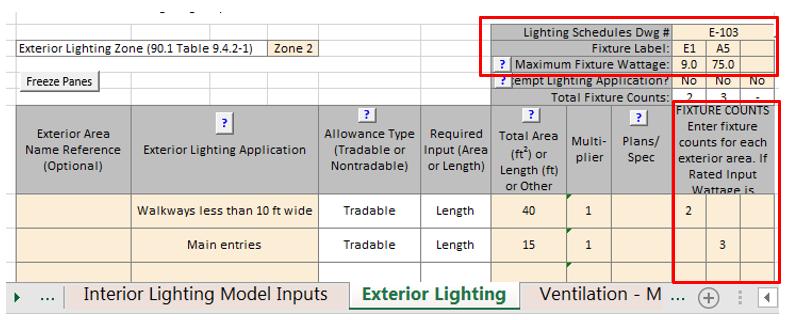
- Use Table 1 of the Exterior Lighting tab to identify lighting fixtures that contribute the most toward the total specified lighting wattage based on the product of the Maximum Rated Fixture Wattage and Total Fixture Counts. Refer to the Lighting Schedule drawings to establish the manufacture and model number for the fixtures. Check the manufacturer information to confirm that the maximum rated fixture wattage reported in the compliance form reflects manufacturer’s data.
-
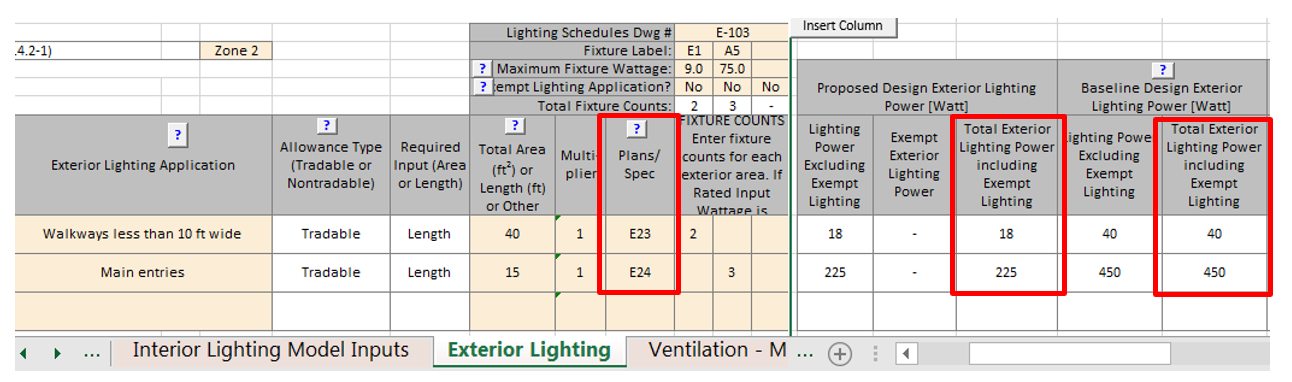
Use Table 1 of the Exterior Lighting tab to identify exterior lighting applications with the
greatest difference in wattage between the baseline and proposed design. (The top contributors
are also shown on the QC tab.) Refer to the exterior lighting plans drawings to confirm that
fixture types and counts for these spaces reported in the Compliance Form match design
documents.
- Common Mistakes
- Proposed fixture wattage is based on the specified lamps and not the manufacturer’s labeled maximum wattage of the luminaire.
- Exterior lighting wattage is excluded for compliance calculations. Submittals with no exterior lighting should be flagged.
LE02-P Specified exterior lighting meets 90.1 mandatory requirements.
Review Tips
-
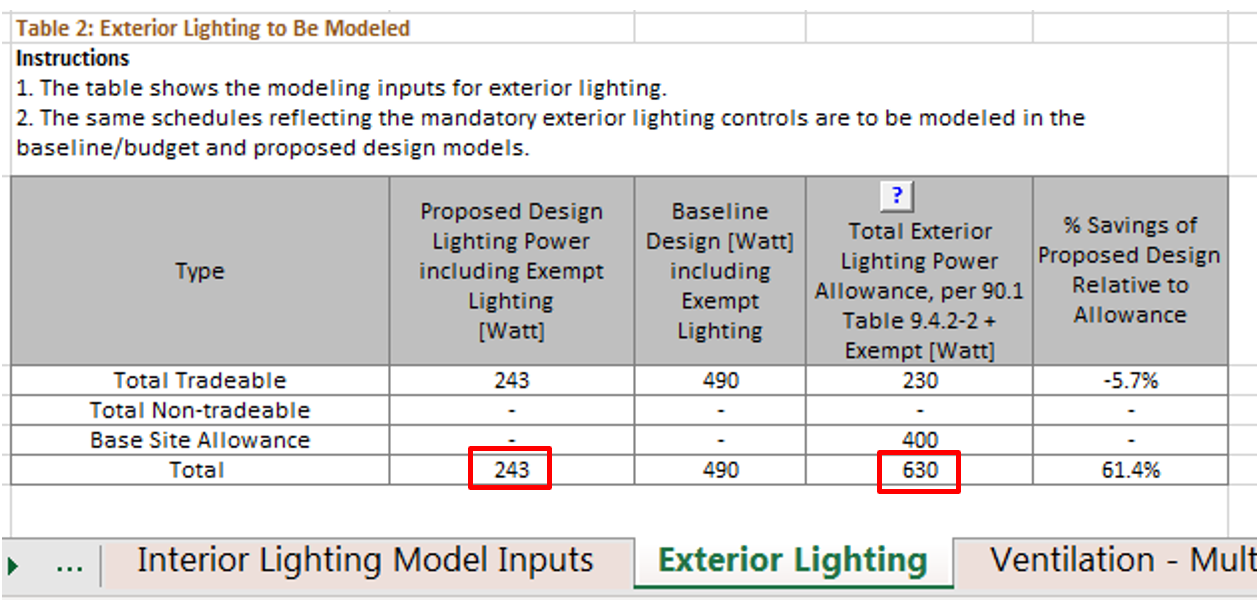
Table 2 of the Exterior Lighting tab shows the total specified exterior lighting wattage
alongside the total exterior lighting power allowance in Table 9.4.2.2. Since the exterior
lighting requirements are mandatory, projects where the total specified exterior lighting
exceeds the exterior lighting power allowance should be flagged as not complying with 90.1.
Refer to the
90.1 2022 Section G3.3
Performance Calculations for Other
Alterations
section for review tips for alterations subject to 90.1 2022 Section G3.3 (i.e., Minor
Alterations).
- Lighting fixtures used for exterior lighting applications and the maximum fixture rated wattage for each
- Number of fixtures of each type specified for each exterior lighting application.
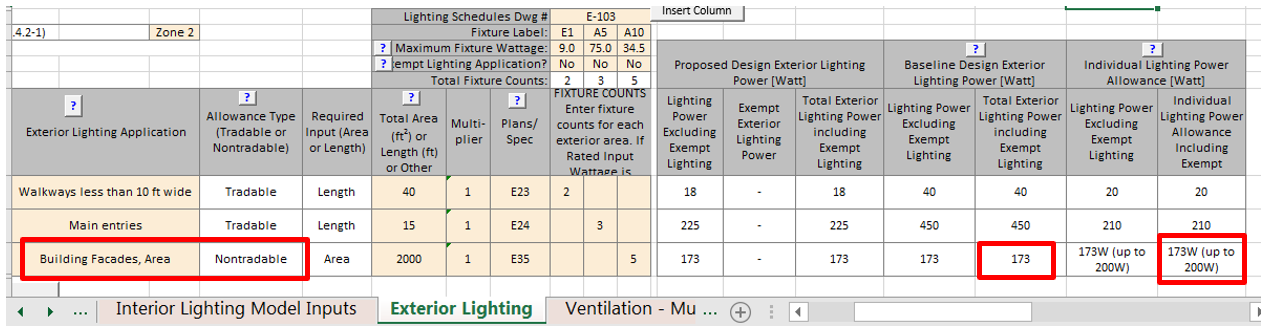
- Table 1 of the Exterior Lighting tab shows the total wattage of exterior lighting specified for
the individual non-tradeable exterior lighting applications alongside their corresponding
lighting power allowances from Table 9.4.2.2-2. Projects where specified lighting for at least
one non-tradeable exterior lighting application exceeds the corresponding allowance should be
flagged as not complying with 90.1. Refer to the 90.1 2022 Section G3.3 Performance Calculations
for Other Alterations section for review tips for alterations subject to 90.1 2022 Section G3.3
(i.e., Minor Alterations).
LE03-B, LE03-P Modeled baseline/budget and proposed exterior lighting power reflects the wattages reported in the Compliance Form.
Review Tips
-
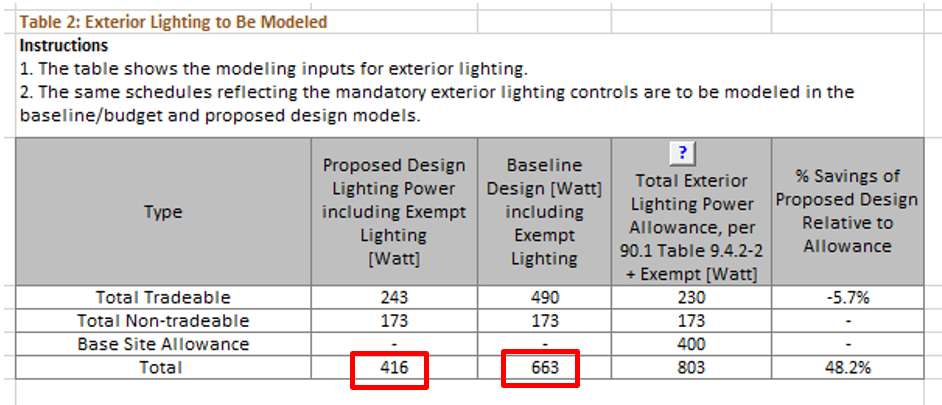
The modeled baseline/budget exterior lighting wattage must reflect the values reported in Table
2 of the Exterior Lighting tab (refer to the
90.1 2022 Section G3.3 Performance Calculations for Other Alterations
section for the location of the baseline lighting wattage for alterations subject to 90.1 2022
Section G3.3).
- Depending on the reporting capabilities of the simulation tool used on the project, the inputs
can be verified in the input or output reports, as follows
- Use simulation input reports to verify that the exterior lighting wattage entered into the simulation tool matches the wattage reported in the submittal.
- Use simulation output reports to verify that the modeled lighting peak demand does not exceed the exterior lighting wattage reported in the submittal. The exterior lighting peak demand occurs at night and thus does not coincide with the building overall electricity peak which occurs in the late afternoon for most building types.
PLD <= LTW
PLD [kW] = peak exterior lighting demand based on the simulation output reports
LTW [kW] = design exterior lighting wattage reported in the submittal
LE04-P Exterior lighting controls reported in the Compliance Form reflect design documents
Refer to the Exterior Lighting tab of the Compliance Form to confirm that the exterior lighting controls are reported as specified. Focus on exterior lighting applications that account for the largest reported exterior lighting wattage.
LE04-B Exterior lighting controls reported in the Compliance Form for the baseline/budget design are established correctly
Exterior lighting controls must be the same in the baseline/budget as in the proposed design. No trade-offs in this area are allowed by either the Energy Cost Budge Method or the Performance Rating Method.
LE05-P Specified exterior lighting controls meet 90.1 mandatory requirements
90.1 2016, 2019 and 2022 The Energy Cost Budget and Performance Rating Methods
Section 9.4.1.4 includes exterior lighting control requirements. This section is mandatory, and thus must be met by project documenting compliance following Energy Cost Budget Method or Performance Rating Method.
Exterior lighting controls must be the same in the baseline/budget as in the proposed design. No trade-offs in this area are allowed by either the Energy Cost Budge Method or the Performance Rating Method.
Review Tips
Review design documents to confirm that exterior lighting controls required in Section 9.4.1.4 are met.
LE06–P Modeled exterior lighting runtime hours in the proposed design are reasonable
Review Tips
- Following Section 9.4.1.4, in 90.1 2016 and 2019 the exterior lighting must be controlled to
turn off when sufficient lighting is available and turned off or operate at a wattage reduced by
at least 50%, during non-business hours (applies to most exterior lighting applications 90.1
2022). These controls are mandatory and thus must be specified on all projects. Thus, the
modeled exterior lighting runtime may be up to 12 hours / day (4,380 hours per year) for
facilities opened 24/7, such as hospitals. Lower runtime (e.g., 6 hours per day) is expected for
other building types due to lighting control requirements in 90.1 Section 9.4.1.4.
EFLH= LEU / LTW
EFLH [hrs/yr] = exterior lighting effective full load hours
LEU [kWh] = annual exterior lighting energy use, based on the simulation output reports
The review check should be performed only for Performance Rating Method projects.
- EFLH>4380 should be flagged as a likely error
- EFLH<2190 (less than 6 hours per day) are reasonable for non-24/7 facilities and should be accepted.
- EFLH between 2190 and 4380 should be investigated on Performance Rating Method projects that have proposed exterior lighting energy use significantly lower than the baseline.
LE07 Difference between the baseline/budget and proposed exterior lighting energy is as expected
Review Tips
- 90.1 2016/2019/2022 Energy Cost Budge Method : Since exterior lighting is not a trade-off opportunity, the annual exterior lighting kWh must be the same in the budget and proposed design. Energy Cost Budge Method projects with different exterior lighting energy use in budget vs proposed design should be flagged.
-
90.1 Performance Rating Method : Since the exterior lighting controls (i.e., lighting
runtime) must be the same between the baseline and proposed design, the difference in the
annual baseline versus proposed exterior lighting use is expected to be directly
proportional to the difference in the exterior lighting wattage reported in the Table 2 of
the Exterior Lighting tab of the Compliance Form. For example, if the proposed exterior
lighting wattage reported in the submittal is 20% lower than the baseline, the proposed
exterior lighting kWh are expected to be also 20% lower than the baseline exterior lighting
kWh. Projects where this relationship does not hold should be flagged.
Performance Rating Method : LTWprop / LTWbase = LEUprop / LEUbase
Energy Cost Budge Method : LEUprop = LEUbudget