Review Methodology
Identifying the Impactful Aspects of the Submittal
This section provides tips for identifying systems and components, and the related modeling inputs, that have a significant impact on the compliance outcome and that should be targeted in the reviews. The impactful building systems and components may be established using a three-step process described below.
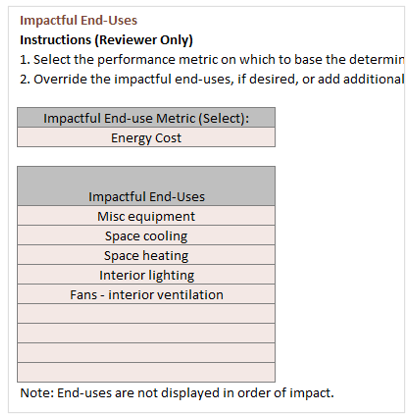
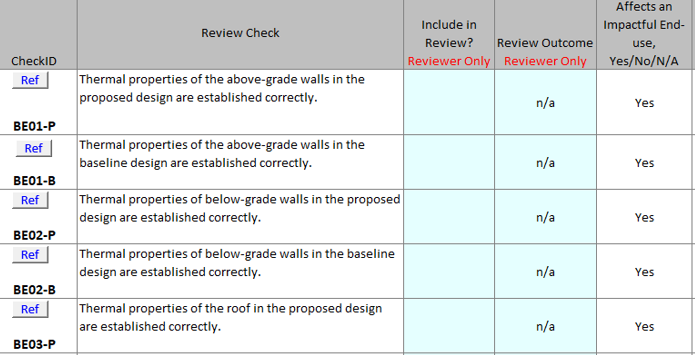
Impactful end-uses are identified automatically in the Compliance Form using the methodology described in this section. In addition, the review checks affected by impactful end-uses (i.e., the review check deals with systems and components that affect the impactful end-use) are also automatically determined in the Compliance Form. See Figure 6 and Figure 7 below for excerpts from the Compliance Form.
Step 1: Identify the impactful end uses
End uses that fall into the top tier based on any of the following criteria should be considered impactful:
-
Contribution toward the difference in energy use between the baseline/budget and proposed design:
For example, lighting end use should be considered impactful for both the baseline and proposed design if reduction in lighting energy use of the proposed design relative to the baseline is one of the top three contributors toward the total reported savings. (In this example, the top tier is defined as top three end uses.) - Contribution toward the total energy use of the proposed design, except when the trade-offs for the end use are not allowed
-
The relative contribution toward the total energy use of the budget/baseline design, except when the trade-offs for the end use are not allowed
Criteria (b) and (c) are important because there are typically multiple differences between the systems and components of the budget/baseline versus proposed design that affect a given end use. Some of the differences may result in energy savings while others in energy penalty. For example, the proposed design may have a less efficient envelope, but a more efficient heating system compared to the budget/baseline, resulting in a similar heating energy use in the budget/baseline and proposed design. In such scenarios, criteria (a) may not be triggered, but criteria (b) and (c) would apply if heating end use is a significant contributor toward energy use of the budget/baseline or proposed design. This will ensure that the trade-offs between envelope and heating are evaluated as part of the review.
Criteria (b) and (c) are not applicable to end uses for which no trade-offs are allowed, such as miscellaneous equipment for projects following 90.1 Section 11 (called Section 12 in 90.1-2022) or documenting the minimum compliance following 90.1 Appendix G, or exterior lighting for projects following Section 11 (called Section 12 in 90.1-2022).
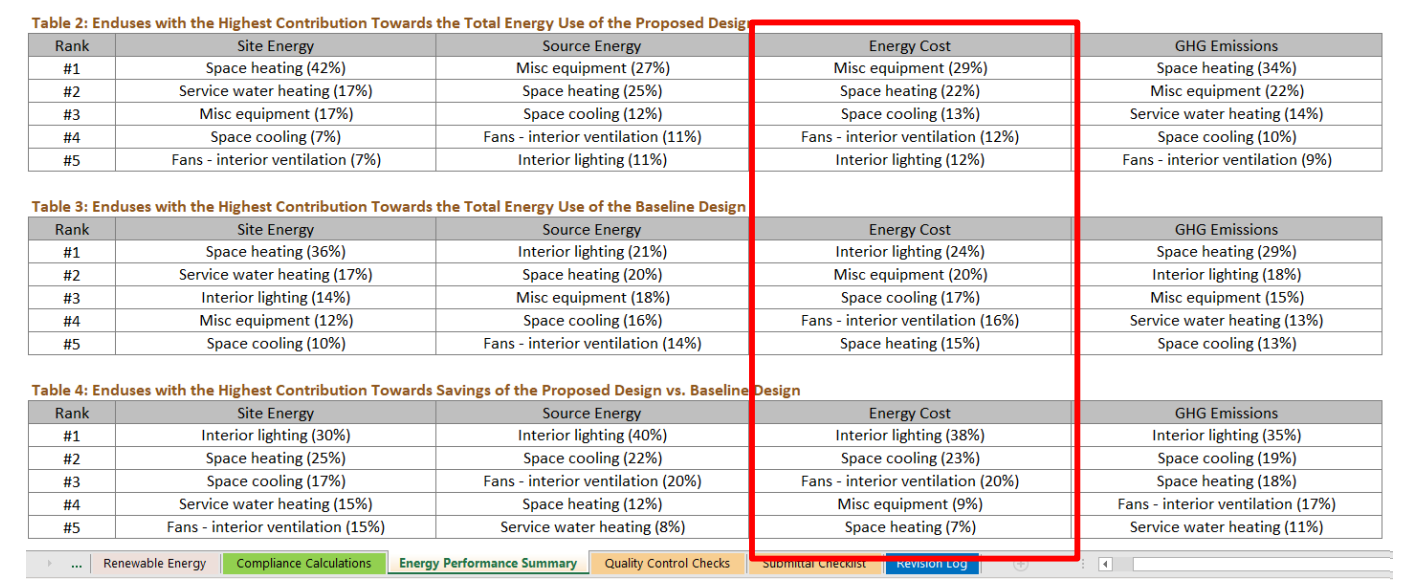
Tables 2-4 of the Energy Performance Summary tab of the Compliance Form rank the end uses based on these criteria using simulation results reported in the Compliance Calculations tab (Figure 8). The ranking may be different depending on units used to express simulation results. Since 90.1 Energy Cost Budget and Performance Rating Method compliance is based on energy cost, the impactful end uses should also be determined on the cost basis. Alternative units may be used when required by AHJ or rating authority. It is important to note that for projects with utility rate structures that include demand charges, the cost impact of these charges on each end-use is not accounted for when automatically determining impactful end-uses in the Compliance Form for the energy cost metric. This is because the cost calculation relies on average or virtual rates and the kWh consumption of each end-use.
Step 2: Identify the impactful systems and components
Systems and components associated with the impactful end uses are shown in Table 1 and should be considered impactful. Impactful end-uses are identified automatically in the Compliance Form. The impactful end-uses used to determine impactful review checks are shown in the Impactful End-uses section on the Quality Control Checks tab in the Compliance Form. These can be overwritten by the reviewer as desired.
Step 3: Identify the performance characteristics and operating conditions that drive the modeled energy use of the impactful systems and components
The performance characteristics and operating conditions that drive the modeled energy use of the impactful systems and components are shown in Table 1. The review checks affected by impactful end-uses (i.e., the review check deals with systems and components that affect the impactful end-use) are also automatically determined in the Compliance Form. See Figure 7 for an excerpt of a sample of checks from the Compliance Form showing this concept.
Table 1: Impactful Systems and Components to be Reviewed
| Lighting End Use | |
|---|---|
| Performance Characteristics | Operating Conditions |
|
i. Wattage of the lighting fixtures which account for at least 10% of the lighting power
based on the fixture wattage and quantity. ii. Lighting controls in a representative sample of spaces. |
i. Lighting runtime hours in a representative sample of spaces. |
| Service Water-heating End Use | |
| Performance Characteristics | Operating Conditions |
|
i. Type, capacity and efficiency at full and part load of the service water heaters that
account for 25% or more of the total specified or installed capacity. ii. Supply hot water temperature. |
i. Volume of hot water consumed. |
| Space Heating End Use | |
| Performance Characteristics | Operating Conditions |
|
i. Type, capacity and efficiency at full and part load of the space heating systems accounting for
25% or more of the total specified or installed capacity. Where there are multiple systems of the
same type, the combined capacity of all systems of that type shall be compared to the 25% threshold. ii. In envelope-dominated building types including multifamily, hotels/motels, dormitories and schools: - For each opaque surface type*: U-factors and area of assemblies accounting for 25% or more of the total opaque surface area of this type - For fenestration: window to wall ratio; U-factor and area of assemblies accounting for 25% or more of the total fenestration area - Infiltration rate iii. Mechanical ventilation rate iv. Exhaust air energy recovery including recovery effectiveness and bypass control v. HVAC system controls |
i. Hourly heating thermostat setpoints ii. HVAC control setting iii. Mechanical ventilation schedule |
| Space Cooling and Heat Rejection End Use | |
| Performance Characteristics | Operating Conditions |
|
i. Type, capacity and efficiency at full and part load of the space cooling systems accounting for
25% or more of the total specified or installed capacity. Where there are multiple systems of the
same type, the combined capacity of all systems of that type shall be compared to the 25%
threshold. ii. Fenestration SHGC. iii. Infiltration rate in the envelope-dominated occupancies including multifamily, hotels/motels, dormitories and schools. iv. Mechanical ventilation rates. v. Exhaust air energy recovery including recovery effectiveness and bypass control vi. Economizer operation. vii. HVAC system control. |
i. Hourly cooling thermostat setpoints ii. HVAC control setting iii. Mechanical ventilation schedule |
| Fan End Use | |
| Performance Characteristics | Operating Conditions |
|
i. Type, rated flow CFM, BHP, flow control method, minimum specified flow fraction, fan and
motor efficiency at full and part load for fans serving air-side systems identified as
impactful. ii. Mechanical ventilation rate and schedule relevant to the identified fans. iii. HVAC system controls relevant to the identified fans. |
i. Fan full load hours ii. The hourly ratio of actual flow to design flow |
| Other HVAC Equipment (e.g., Pumps) End Use | |
| Performance Characteristics | Operating Conditions |
|
i. Type, rated flow GPM, BHP, flow control method, minimum specified flow fraction, pump
and motor efficiency at full and part load for pumps serving heating or cooling loops associated
with the systems identified as impactful. ii. HVAC system controls relevant to the identified pumps |
i. Pump full load hours ii. The hourly ratio of actual flow to design flow |
| Other End Uses | |
| Performance Characteristics | Operating Conditions |
| i. Peak and daily average kW load for systems and equipment that combined account for at least 75% of the rated design kW of all equipment associated with this end use. Examples include but not limited to refrigeration equipment and elevators. | i. Equipment full load hours |
*= Exterior wall, roof, exposed floor, interior surfaces adjacent to unconditioned spaces, etc.