Review Methodology
General Concept of Standard 90.1 ECB and PRM Compliance
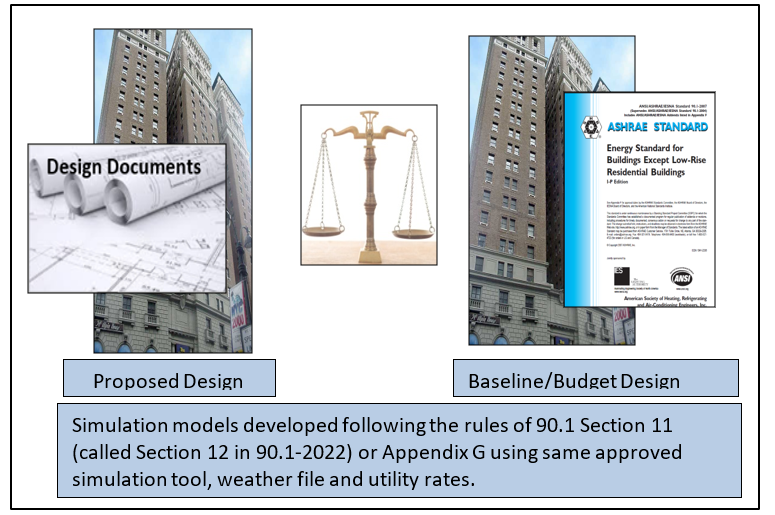
The performance path allows projects to not meet some of the prescriptive requirements and make up for the associated energy penalty by improving over mandatory and prescriptive provisions in other areas. For example, projects with high window to wall ratio may demonstrate compliance by showing that the energy penalty associated with the high thermal loads is offset by savings from an efficient HVAC system and daylighting. The required analysis involves developing two whole building energy simulation models. The first model establishes the point of reference and is referred to as budget (90.1 Energy Cost Budget Method which is also known as Section 11 in 90.1 2016 and 2019 and Section 12 in 90.1 2022) or baseline (90.1 Performance Rating Method which is also known as Appendix G) building design. The second model represents the building design based on the design documents. The compliance outcome is established by comparing the simulated annual energy cost of the two models. This general concept is illustrated in Figure 5.